
Focus Area 4
Advance novel approaches and research innovation to better meet people’s diverse contraceptive needs and preferences
Context
Since 2022, the CECA has brought together evidence and diverse stakeholders to understand the impact of shifts in the sexual and reproductive health landscape, foster strategic collaboration, and improve contraceptive access and sexual and reproductive health equity (SRHE) more broadly.
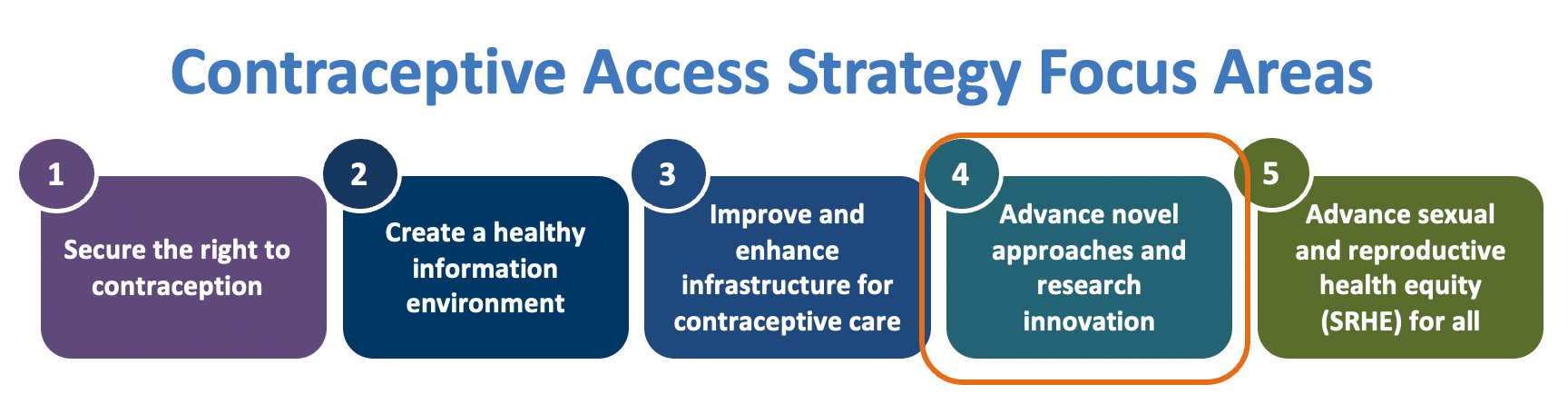
The resulting Strategy to Preserve and Expand Contraceptive Access features five focus areas that detail what we aim to achieve and communicate where people should direct their work, recommended actions to prioritize and move forward now, and examples of work completed or underway.
Recommended Actions to Advance Novel Approaches and Research Innovation
Expand innovations in contraceptive care delivery, such as telehealth for contraceptive care, over-the-counter hormonal contraception, and pharmacist-prescribed contraception, by increasing awareness of delivery approaches among providers and the public; developing pathways for consistent, adequate reimbursement for services; and engaging communities to inform person-centered delivery of care.
Improve contraceptive science and technology by investing resources to develop and evaluate new contraceptive methods that align with individuals’ needs and preferences and minimize side effects.
Advance collaborative, high-quality research that improves contraceptive care delivery and access, informs policy-making, and aligns with the equity-informed principles for contraceptive access research. Priority areas for future research include:
How have restrictive SRH policies affected access to, preferences for, use of, and provision of contraception?
What is the extent, nature, and impact of mis- and disinformation on the public, providers, and policymaking?
How has the current state of the contraceptive care workforce been affected by recent SRH policy restrictions, including Dobbs?
What is the impact of new care delivery models on contraceptive access?
What new approaches and technology are needed to meet the contraceptive preferences and needs of all people (e.g. individuals of all body sizes)?
How can person-centered measurement help reflect people’s SRH experiences?
